Why Auburn Homeowners Need Expert Roofers
Auburn occupies a unique geographic position in the southern reach of King County, straddling the Green River valley at the transition point between suburban Puget Sound and the rural Cascade foothills. The city stretches from the flat valley floor along the Green River — elevation just 70 feet above sea level — up through the elevated residential plateaus of Lea Hill (approximately 500 feet) and West Hill, creating dramatic elevation variation that directly impacts roofing performance. Auburn's position also makes it one of the most wind-exposed cities in King County: Cascade gap winds from the Stampede Pass corridor funnel through the Green River valley with particular force, producing sustained gusts during fall and winter storms that exceed what more sheltered Eastside cities experience. With roughly 39 inches of annual rainfall spread across 150+ days, combined with this wind exposure, Auburn roofs face a dual assault of moisture and mechanical stress that demands roofing systems engineered for both.
Auburn's history as an agricultural and industrial hub — the city was the hop capital of the world in the early 1900s — has shaped a housing stock remarkably varied in age and construction style. The post-war suburban boom brought residential development to West Hill and the valley floor, while Lea Hill on the city's eastern ridge developed later with a mix of 1980s-2000s tract homes and custom builds. The master-planned Lakeland Hills community south of downtown, developed primarily from the late 1990s through the 2010s, represents Auburn's newest large-scale residential area and features HOA-governed communities with specific roofing material and color requirements. Many of the older homes on West Hill were originally roofed with cedar shake or early three-tab composition shingles, and over the decades they have been overlaid with additional layers rather than stripped to bare decking. These multi-layer roofing systems are a defining challenge of Auburn's older neighborhoods: they trap moisture between layers, mask underlying deck rot, and add dead weight that stresses the roof structure.
The Meridian corridor and the newer residential developments along Auburn's eastern fringe represent a different era of construction. Homes built during the building boom of the late 1990s and 2000s in these areas typically feature more complex rooflines with multiple valleys, dormers, and hip-to-gable transitions. While these homes were built with single-layer architectural shingles rather than the overlaid systems found in older neighborhoods, the builder-grade materials specified during that construction boom are now reaching the end of their 20- to 25-year warranty period. Homeowners in Meridian and the surrounding developments are discovering that the shingles installed by original builders are curling at the edges, shedding granules onto the gutters, and showing signs of thermal cracking well before the marketed lifespan implied they would need replacement.
The Auburn Station area and the neighborhoods surrounding downtown have undergone significant revitalization over the past decade. This urban core includes a mix of older commercial-adjacent residential properties, townhome developments, and renovated single-family homes. Roofing work in these areas presents its own set of considerations, including tighter lot lines that require careful staging and debris management, proximity to neighboring structures that demands precise flashing work, and the occasional presence of flat or low-slope roofing systems on mid-century commercial-residential conversions that require membrane or modified bitumen solutions rather than standard shingle installations.
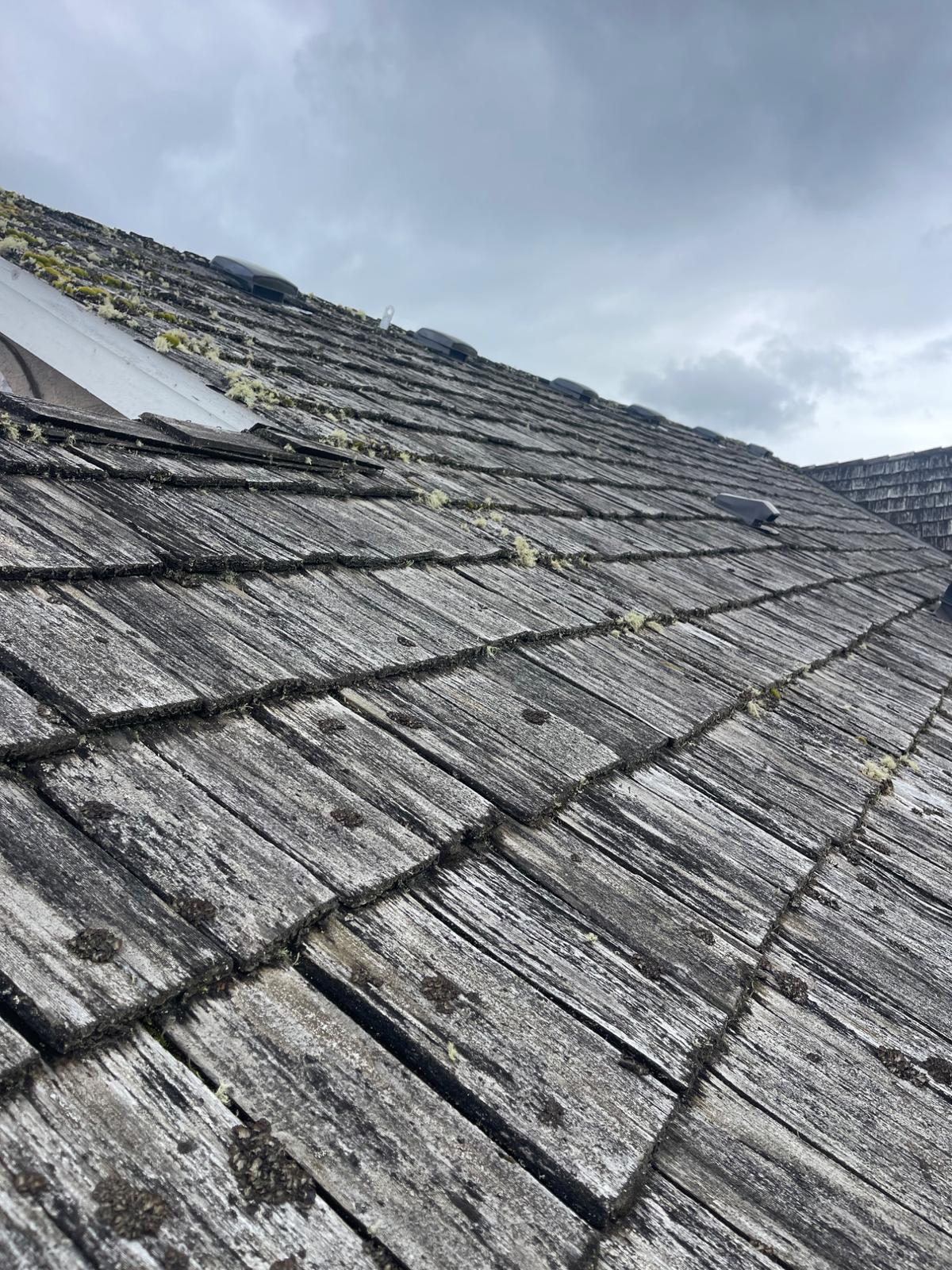
The Panther Lake neighborhood, located in the northern reaches of Auburn near the border with Renton, is characterized by mature tree canopy, winding residential streets, and homes built primarily in the 1970s through 1990s. The heavy shade created by the established trees in Panther Lake makes this one of Auburn's most moss-prone areas. Roofs that might maintain relatively clean surfaces in the more open valley-floor neighborhoods can develop thick moss colonies within a year or two in Panther Lake's shaded environment. This biological growth works beneath shingle tabs, lifts edges, and creates water infiltration pathways that cause damage long before the leak becomes visible from inside the home.
Scenic Hill and Auburnridge occupy elevated positions on Auburn's western hillside, offering views across the valley but also exposing homes to higher wind loads and greater thermal cycling than valley-floor properties experience. During fall and winter storms, these hillside neighborhoods bear the brunt of southwesterly winds that can gust above 50 miles per hour, testing the wind resistance of every shingle tab and flashing detail. Homes on Scenic Hill and Auburnridge need roofing systems that are rated for enhanced wind performance, with proper starter strip installation, six-nail patterns on steep slopes, and wind-resistant ridge cap details that prevent the uplift failures we commonly see on hillside homes roofed with less rigorous installation methods.
Services We Offer in Auburn
Mass & Mass LLC delivers the full spectrum of roofing and exterior services to Auburn homeowners. From complete roof system replacements to targeted repairs and preventive maintenance, every project we undertake is backed by CertainTeed ShingleMaster™ certification and our commitment to transparent pricing, quality materials, and meticulous craftsmanship.
Roof Replacement
A full roof replacement is the most reliable way to protect your Auburn home for the next 25 to 50 years. We install CertainTeed Landmark PRO architectural shingles, standing seam metal roofing, and flat roof membrane systems, with particular attention to the underlayment, ventilation, and flashing details that determine long-term performance in Auburn's high-moisture valley environment. Our ShingleMaster certification qualifies us to offer the SureStart PLUS warranty, providing 50-year product coverage and 25-year workmanship coverage at no additional cost. For Auburn valley homes where drainage is a constant concern, we pay special attention to drip edge installation and gutter integration to ensure water moves efficiently off the roof and away from the foundation.
Roof Repair
Not every roofing problem demands a full replacement. Our roof repair services address active leaks, wind-damaged shingles, deteriorated flashing around chimneys and skylights, and localized storm damage. We trace every leak to its source rather than applying surface-level patches, ensuring your repair investment delivers lasting results. Auburn's combination of valley-floor moisture and hillside wind exposure demands precision repairs that account for both vertical rainfall penetration and horizontal wind-driven water intrusion, and our crews are trained to deliver exactly that level of detail.
Emergency Roof Repair
When a Pacific Northwest windstorm tears shingles from your Auburn home or a falling branch punctures the roof deck, immediate response is critical. Our emergency roof repair team provides 24/7 storm response throughout Auburn. We arrive quickly to tarp exposed areas, prevent further water intrusion, and then schedule permanent repairs as soon as weather conditions allow safe work. Auburn's valley location can channel storm winds along the Green River corridor, creating localized damage patterns that require rapid professional assessment and response.
Roof Inspection
A professional roof inspection is the smartest preventive investment any Auburn homeowner can make. We conduct thorough exterior and attic inspections supplemented by drone photography, producing a detailed visual record of your roof's condition. Our inspections are always free and carry no obligation. We identify moss buildup, failing flashing, ventilation problems, and early-stage shingle deterioration before they escalate into expensive emergencies. For Auburn homes in flood-adjacent zones near the Green River, we also assess whether moisture is migrating upward from foundation-level saturation into attic spaces through inadequate vapor barriers.
Moss Removal
Moss thrives in Auburn's shaded, moisture-rich environment, and left untreated it will shorten your roof's lifespan by years. Our moss removal service uses gentle, low-pressure treatment methods that eliminate moss without damaging your shingles. We also install zinc or copper ridge strips that create a natural antimicrobial barrier, inhibiting regrowth and extending the interval between professional treatments. Homes in Panther Lake and the tree-lined streets of Lea Hill particularly benefit from this preventive approach, where heavy canopy shade creates ideal conditions for rapid moss recolonization after treatment.
Gutter Installation
Auburn's sustained rainfall and valley-floor drainage challenges demand a gutter system engineered for high-volume water management. Our gutter installation service includes custom-fabricated seamless aluminum gutters, properly sized downspouts, and optional leaf guard systems that dramatically reduce the maintenance burden created by Auburn's abundant tree canopy. Every gutter run is precision-pitched and secured with hidden hangers for clean lines and reliable drainage. For Auburn valley homes on flat lots where water pooling near the foundation is a concern, we design downspout discharge systems that direct water well away from the structure.
Storm Damage Repair
Fall and winter storms regularly batter Auburn with high winds, heavy rain, and occasional hail. Our storm damage repair service covers everything from scattered shingle blow-offs to major structural damage caused by fallen trees. We have extensive experience working with homeowner insurance companies and provide the detailed photography, damage documentation, and itemized estimates that adjusters need to process your claim efficiently. Auburn's exposure to channeled valley winds means storm damage is a frequent concern, particularly on the hillside neighborhoods of Scenic Hill and Auburnridge where wind uplift forces are strongest.
Siding
Your roof cannot protect your home alone. Deteriorated or aging siding allows moisture to penetrate wall cavities, causing rot, mold growth, and insulation failure. We install James Hardie fiber cement, vinyl, and LP SmartSide siding systems that complement your new roof and establish a unified moisture barrier around your entire home's exterior envelope. Many Auburn homes built in the 1960s and 1970s still have original wood or early vinyl siding that has long since passed its useful life and is allowing moisture intrusion that undermines the protection your roof provides from above.
Exterior Painting
A quality exterior paint job protects your home's siding, trim, and fascia between major renovations. Our exterior painting crews apply premium Sherwin-Williams and Benjamin Moore products with thorough surface preparation, delivering adhesion and durability that withstands Auburn's year-round moisture exposure and the wide temperature swings that hillside homes on Lea Hill and Scenic Hill experience between seasons.
Auburn-Specific Roofing Challenges
Green River Valley Moisture and Drainage
Auburn's defining geographic feature is its position in the Green River valley, a broad, low-lying corridor that channels moisture-laden air from the Puget Sound and creates a microclimate with elevated humidity levels that persist year-round. The valley floor, where much of Auburn's commercial and residential development is concentrated, sits at an elevation of roughly 25 to 50 feet above sea level. This low elevation, combined with the Green River's proximity and the region's high water table, means that homes in the central and western portions of Auburn contend with moisture from both above and below. Roofing materials in this environment stay damp for extended periods after rainfall, accelerating the chemical and biological degradation processes that shorten roof lifespans.
The drainage challenges extend beyond the roof surface itself. On Auburn's flat valley-floor lots, water that cascades off the roof often pools near the foundation rather than flowing away naturally as it would on sloped terrain. This means the gutter and downspout system is not just an accessory but a critical component of the overall moisture management strategy. At Mass & Mass, we approach every Auburn roofing project with this holistic perspective, ensuring that the roof system, underlayment, gutters, and discharge points work together to move water efficiently away from the structure. We specify CertainTeed Landmark PRO shingles with StreakFighter® algae-resistant technology as our standard recommendation for Auburn homes, paired with enhanced synthetic underlayment that provides a secondary moisture barrier even if individual shingles are compromised.
Older Homes and Multi-Layer Tear-Offs
Auburn's housing stock includes thousands of homes built during the 1960s and 1970s residential expansion that accompanied the city's growth as a manufacturing and agricultural center. These homes, concentrated on Lea Hill, West Hill, and the older sections near downtown, frequently have roofing systems that have been overlaid multiple times over the decades. It was common practice in previous generations to simply nail a new layer of shingles over an existing worn layer rather than tearing down to bare decking. While this approach saved money in the short term, it created a compounding problem: each layer traps moisture against the layer beneath it, accelerating rot in the plywood decking and creating a heavy, spongy roof structure that is far less effective at shedding water than a clean single-layer installation.
Washington State building code, which Auburn enforces, prohibits the installation of a third layer of roofing material. When we encounter a two-layer roof in Auburn, a complete tear-off to bare decking is required. Our crews routinely discover significant decking damage during these tear-offs, particularly in homes near the Green River where ground-level moisture has migrated upward through inadequately ventilated attic spaces. We always have replacement plywood and OSB decking material on-site during Auburn tear-offs so that discovered deck damage can be repaired immediately without delaying the project or leaving the home exposed overnight.
Temperature Swings Between Valley and Hillsides
One of Auburn's less obvious roofing challenges is the temperature differential between the valley floor and the hillside neighborhoods. On clear winter nights, cold air settles into the valley, creating temperature inversions where the valley floor can be 10 to 15 degrees colder than the hillside neighborhoods just a few hundred feet higher in elevation. Conversely, on summer afternoons, the valley floor can trap heat while hillside neighborhoods benefit from air circulation. These temperature swings subject roofing materials to repeated thermal cycling that causes shingles to expand and contract, loosening adhesive bonds between tabs, cracking aging materials, and working fasteners loose over time.
Homes on Scenic Hill, Auburnridge, and the upper elevations of Lea Hill are also more exposed to wind, which compounds the thermal cycling stress with mechanical wind uplift forces. For these hillside homes, we specify enhanced wind-rated installation methods, including six-nail patterns, high-wind starter strips, and ridge cap details engineered for uplift resistance. On the valley floor, where cold-weather frost cycles are more extreme, we pay particular attention to flashing details around chimneys, vents, and wall-to-roof transitions where ice formation can create temporary dams that force water beneath shingle courses.
Green River Flooding Proximity
The Green River has a well-documented history of flooding that directly affects Auburn's valley-floor neighborhoods. The Howard Hanson Dam upstream controls much of the river's flow, but during prolonged heavy rain events, floodplain areas in Auburn can experience elevated water levels that saturate the ground around home foundations. While flooding primarily threatens the lower portions of a home, the secondary effects reach the roof: saturated soil raises the water table beneath the home, increasing attic humidity through foundation and crawlspace vapor transmission. This elevated moisture level inside the attic space accelerates wood rot in the roof decking and can cause condensation on the underside of the roof sheathing, creating damage that is invisible from the exterior until it becomes severe.
For Auburn homes in or near the Green River floodplain, Mass & Mass recommends comprehensive attic ventilation assessments as part of every roofing project. Properly balanced intake and exhaust ventilation reduces attic moisture levels, protects the roof decking from interior condensation damage, and extends the overall lifespan of the roofing system. We also inspect vapor barriers and insulation during our free roof inspections, alerting homeowners to conditions that may be causing hidden damage from below even as the roof surface appears intact from above.
Building Permits and Auburn Code Requirements
The City of Auburn requires building permits for re-roofing in certain situations, including when structural repairs to the roof deck are necessary, when the roofing material type is being changed, or when the existing roof has two or more layers that require a complete tear-off. Auburn's building codes align with the International Residential Code and the Washington State Residential Code. The city's planning and building department oversees permitting and inspections for residential roofing work. Mass & Mass handles every aspect of the permitting process on your behalf, from application submission to final inspection coordination, ensuring your project is fully code-compliant and properly documented for your records and future home resale.
Why Choose Mass & Mass for Auburn Roofing
Selecting the right roofing contractor is one of the most consequential decisions a homeowner makes. A poor choice can result in a prematurely failing roof, voided manufacturer warranties, and thousands of dollars in avoidable repair costs. Here is why Auburn homeowners consistently choose Mass & Mass LLC:
- CertainTeed ShingleMaster™ Certified: This is CertainTeed's highest credential for roofing contractors. Only companies that demonstrate proven installation expertise, ongoing training, and proper licensing and insurance earn this designation. It qualifies us to offer the SureStart PLUS warranty, which provides 50-year product coverage and 25-year workmanship coverage at no extra cost to you.
- 500+ Projects Completed: We have completed more than 500 roofing and exterior projects across King County since our founding. That depth of experience means we have encountered and solved virtually every roofing challenge the Pacific Northwest can present, including the valley-specific drainage issues and multi-layer tear-offs that are common in Auburn.
- Local Since 2016: We are not a franchise or a storm-chasing outfit that materializes after a windstorm and vanishes after collecting payment. We are a locally owned and operated company based in Redmond, WA, with deep familiarity with Auburn's neighborhoods, permitting requirements, and the specific roofing challenges the Green River valley climate presents.
- Free Estimates with No Pressure: We provide detailed, itemized proposals that explain exactly what work will be performed, what materials will be used, and what the total cost will be. There are no hidden fees, no high-pressure sales tactics, and no obligation.
- Financing Available: A new roof is a significant investment. We offer financing options for qualified homeowners, making it easier to invest in the quality materials and installation your Auburn home needs without stretching your budget.
- 5-Star Rated: Our 4.9-star Google rating reflects the consistent quality, communication, and professionalism that every Mass & Mass customer experiences from first call to final walkthrough.
Roof Replacement Cost in Auburn
A full roof replacement in Auburn typically ranges from $12,000 to $26,000 for an average-sized single-family home with CertainTeed architectural shingles. This range accounts for the typical Auburn home with 1,200 to 2,200 square feet of roof area, moderate complexity, and a single tear-off layer. Several factors influence where your project falls within this range: Waterfront, unusually large, or steep-pitched roofs commonly exceed the top of that range; we confirm your exact price after a free inspection.
- Roof size and pitch: Larger homes and steeper pitches require more material and labor. Multi-story homes on Scenic Hill and Auburnridge with steep rooflines will generally cost more than single-story ranch homes on Lea Hill's flatter terrain.
- Complexity: Multiple dormers, valleys, skylights, and roof penetrations add time and material to the project. Newer homes in Meridian with complex hip-and-valley rooflines are more involved than the simple gable designs common in Auburn's older neighborhoods.
- Number of tear-off layers: Removing two existing layers of shingles costs more than removing one. Many older Auburn homes, particularly on Lea Hill and West Hill, have multiple layers that must be fully stripped to comply with building code.
- Deck repairs: If the plywood decking beneath your old shingles has rotted due to trapped moisture, which is particularly common in Auburn's valley-floor homes and in multi-layer roof systems, replacement panels add to the total cost.
We provide transparent, itemized proposals so you understand every line item before work begins. Call us at (425) 435-5800 for a free, no-obligation estimate specific to your Auburn home.
Auburn Neighborhoods We Serve
Mass & Mass LLC provides roofing services throughout the entire City of Auburn and surrounding areas, including Lea Hill, West Hill, Meridian, Auburn Station, Panther Lake, Scenic Hill, Auburnridge, Downtown Auburn, and every neighborhood in between. Whether your home sits on a flat valley-floor lot near the Green River or perches on the elevated terrain of Scenic Hill with views across the valley, our crews understand the local conditions, permitting requirements, and roofing challenges specific to your Auburn neighborhood. We also serve homeowners in the unincorporated King County areas adjacent to Auburn, including Covington, Maple Valley, and the communities along the SE 256th Street corridor.